Button
Counts the viewer's presses, so a prop that acts on each change of its value (reset=, refresh=) acts on each press; with set, a press writes other inputs (back to the top of a drill-down).
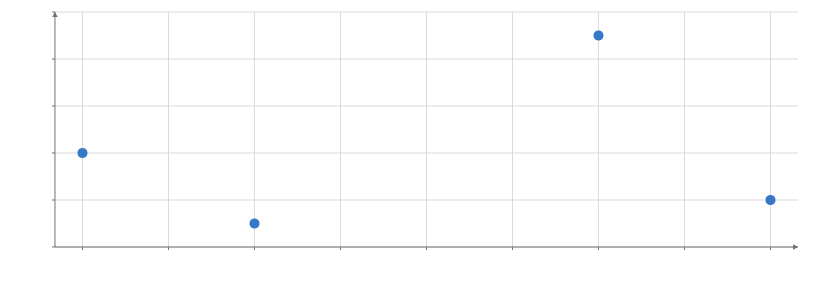
Static preview; loading the interactive plot
<script>
  import { Button, InputContext, Plot, Points, Sample, input } from "hmplot";
  const data = { x: [1, 2, 3, 4, 5, 6, 7, 8], y: [3, 1, 4, 1, 5, 9, 2, 6] };
</script>

<!-- Each press adds one to the button's value, so the Sample draws with a new seed. -->
<InputContext>
  <Button name="draw" />
  <Plot {data} height={300} axes2d>
    <Sample size={4} seed={input("draw")}>
      <Points x="x" y="y" />
    </Sample>
  </Plot>
</InputContext>
Usage
An input sends its value up to the nearest input context (an InputContext, a Python Scene, or a Template instance), and everything in that context reads it by name: input("name") in JavaScript, hm.input.name in Python, or the string "$name" where a string names a column. A read is replaced by the value before its reader sees it, so moving an input re-runs its readers once, and the change animates like any other data change. Inputs go beside Plots (in a Row or Column), not inside them.
A press can also write other inputs: set={root.reset()} puts root back to its default, and set={root.set(literal("all"))} gives it a value, where const root = input("root", { default: "all" }) (Python set=hm.input("root", default="all").reset()). A list writes several. The input need not be a widget’s: marks writing it on click (select={root.set("id")}) and Buttons together declare it, so a Button goes back to the top of a drill-down a click on a rectangle went into. A Button with set needs no name (then give it a label); with a name it also counts its presses.