
Gabriel Hope
- Visiting Assistant Professor
- Swarthmore College
- Office: Martin 236
What to call me
My full name is John Gabriel Hope, but I usually go by Gabe. My pronouns are He/Him.
For students: I generally use “Prof.” Gabe or “Prof.” Hope, but feel free to address me as is comfortable for you.
I am a Visiting Assistant Professor of Computer Science at Swarthmore College. I work primarily in Machine Learning, where I focus on developing methods for scalable approximate inference and applying generative models to problems in the Physical Sciences, Computer Vision and Healthcare.
I received my PhD from the University of California, Irvine, advised by Erik Sudderth. My dissertation, Prediction-Constrained Latent Variable Models, focused on leveraging generative latent variable models for semi-supervised learning. Prior to joining Swarthmore I spent two years as a visitor at Harvey Mudd College.
I also enjoy creating visualizations illustrating concepts in machine learning and statistics. Outside of work I love cooking, board games, racquet sports, travel and music.
Publications
For an up-to-date list of my publications, please see my Google Scholar page.

Variational inference for image reconstruction
Foundational deep generative models (DGMs) such as variational autoencoders and diffusion models are powerful priors for natural images, however posterior inference for reconstruction tasks such as in-painting, super-resolution and de-blurring remains a significant challenge. In this work we introduce expressive variational families for these tasks using DGM priors, yielding considerable performance improvements over heuristic-based sampling methods.
VIPaint: Image Inpainting with Pre-Trained Diffusion Models via Variational Inference · · AISTATS 2026 PDF
· · FPI Workshop at ICLR 2025 PDF
A Decoder Suffices for Query-Adaptive Variational Inference · UAI 2023 (spotlight)PDFSupplement
Material generation with large language models
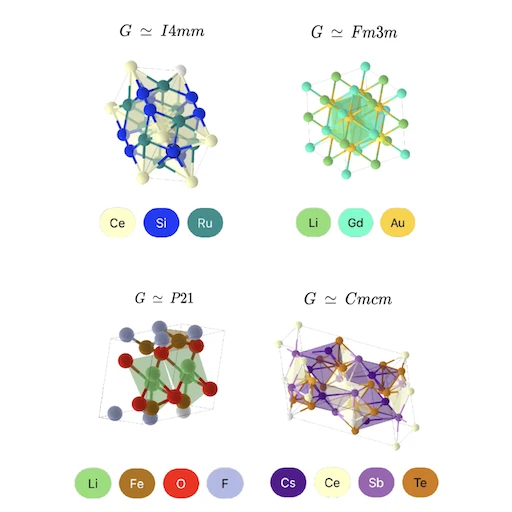
The discovery of new solid-state materials is the foundation of technologies such as solar cells, batteries, and carbon capture. The space of possible materials is enormous, but generative models have proved to be a promising avenue for suggesting candidates for synthesis. In this work we show that large language models can outperform more specialized models for generating stable and novel crystal materials when paired with careful representation design and reinforcement learning leveraging machine learning–based interatomic potential models.
Parameter estimation for non-linear dynamical systems
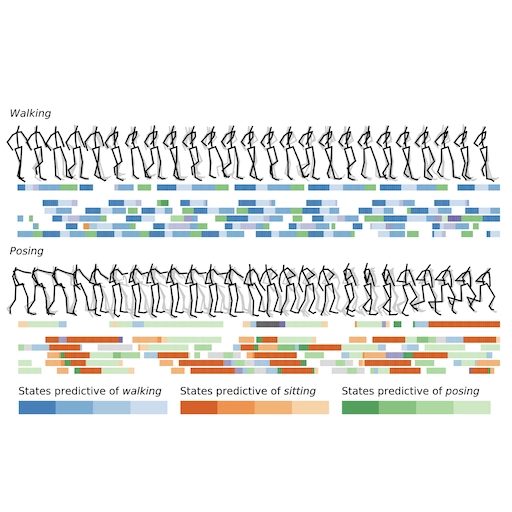
Linear dynamical systems are a critical tool in a wide range of fields ranging from robotics to earth sciences. In many applications, measurements may be a complex and unknown function of the underlying dynamical system, making learning the parameters of both the dynamical system and the measurement model a significant challenge. Structured variational autoencoders (SVAEs) provide an elegant and principled way to apply amortized variational inference to these models. In this work we develop a significantly more stable and scalable approach to training SVAEs allowing for wider adoption.
Unbiased Learning of Deep Generative Models with Structured Discrete Representations · · NeurIPS 2023 PDF
Semi-supervised learning with generative models
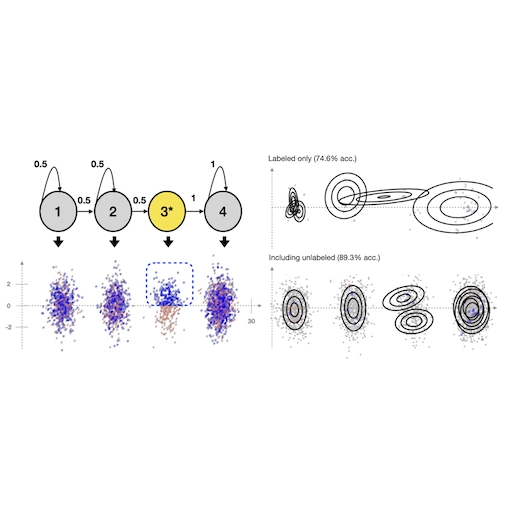
Generative models, that can jointly model the distribution of both inputs and labels, are a natural fit for semi-supervised learning as missing labels can often be exactly or approximately marginalized over. Unfortunately, in practice, joint maximum likelihood training typically produces disappointing results for semi-supervised tasks. In this work we illustrate the flaws of this approach and show that a novel prediction-constrained objective yields better results for a wide range of latent variable models.
Prediction-Constrained Markov Models for Medical Time Series with Missing Data and Few Labels · · Workshop on Learning from Time Series for Health at NeurIPS 2022 (spotlight) PDF
Learning Consistent Deep Generative Models from Sparsely Labeled Data · · Symposium on Advances in Approximate Bayesian Inference 2022PDF
Prediction-Constrained Hidden Markov Models for Semi-Supervised Classification · · Time Series Workshop at ICML 2021 (best poster award)PDF
Semi-Supervised Prediction-Constrained Topic Models · · AISTATS 2018 PDF Supplement
Prediction-Constrained Topic Models for Antidepressant Recommendation · · Workshop on Machine Learning for Health at NeurIPS (NIPS) 2017 PDF
Characterizing insect behaivior with machine learning
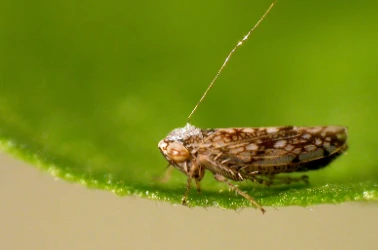
Parasitic insects, such as mosquitos, ticks, aphids, etc., are a significant source of disease transmission. These insect-borne diseases can be devastating to both humans and to food sources such as crops and livestock. Unfortunately, in many cases the exact mechanism of disease transmission is not well understood. Electropenetrography (EPG) is an important technique for studying the feeding behavior of parasitic insects when direct observation is challenging due to the small size of the subjects and the insertion of mouthparts into the host. By measuring changes in electrical resistance in an insect-host system, feeding behaviors can be effectively studied, allowing for the development of improved defenses with minimal environmental impact.
Currently, signals collected through EPG need to be manually annotated for analysis. As feeding sessions can last hours or even days, this annotation is costly, time-consuming and subjective, creating a significant bottleneck for research. The goal of this project is to develop a machine learning system that can help speed up the process of annotating EPG recordings, improve reproducibility and identify new behaviors.
Model evaluation for automated scoring of electropenetrography waveform data from mosquitoes · ·
Teaching
I am passionate about computer science education and have had the pleasure to teach at a number of wonderful institutions over my career.
Fall 2026 — CS63 Artificial Intelligence
Spring 2026 — CS91R Special Topics: Advanced Machine Learning
Fall 2025 — CS66 Machine Learning
Spring 2025 — CS152 Neural Networks, CS186 Data Analytics and Visualization
Fall 2024 — CS186 Data Analytics and Visualization
Spring 2024 — CS152 Neural Networks, CS140 Algorithms
Fall 2023 — CS152 Neural Networks
UC Irvine: CS177 Applications of Probability in Computer Science; CS178 Machine Learning
Brown University: CSCI1420 Machine Learning
Washington University in St. Louis: CSE 131 Introduction to Computer Science; CSE 332 Object-Oriented Software Development Laboratory; CSE 517 Machine Learning
East Harlem School at Exodus House: 6th Grade Math & Social Studies
Work with me
Swarthmore students
If you are a current Swarthmore student interested in joining my research group, please first take a look at my current projects below. If there is a project that interests you send me an email with the subject line: “Interested in research”. Indicate the project(s) you interested in and include 2-3 paragraphs summarizing why you are interested in the project and your relevant prior experience.
Please note that currently due to time constraints, I need to be especially selective with the students I take on. I hope to have more capacity for new students in the future, so if you don’t hear back from me this semester, please reach out again!
Everyone else
If you are interested in collaborating, feel free to send me an email!
Other Projects
Understanding generative AI through visualization

Machine learning and generative AI have had enormous impacts on society in the past few years. With this has come significant growth in the number of students interested in learning about these topics. Despite this growth, there are few high-quality tools available for building intuition about the methods used in AI in an intuitive, hands-on way. In cases like diffusion models, students can often grasp the surface-level intuition, but struggle to understand the important details necessary to develop models in practice.
The goal of this project is to develop a suite of web-based interactive visualizations to illustrate the inner workings of neural networks and diffusion models, building on previous tools I have developed over the years.
Predicting seasonal rainfall

Predicting the level of rainfall to expect in a given year’s rainy season is a task of critical importance to farmers, water resource managers and environmental analysts. Unfortunately, while modern weather models are quite accurate at predicting rain up to about 10 days in advance, they are unable to accurately predict forward on the seasonal scale of weeks to months. Machine learning is a promising direction for bridging this gap, but basic methods fail due to the small amount of available data.
The goal of this project is to develop Bayesian machine learning models for rainfall forecasting with strong, physically-informed priors to account for the sparsity of available data.